
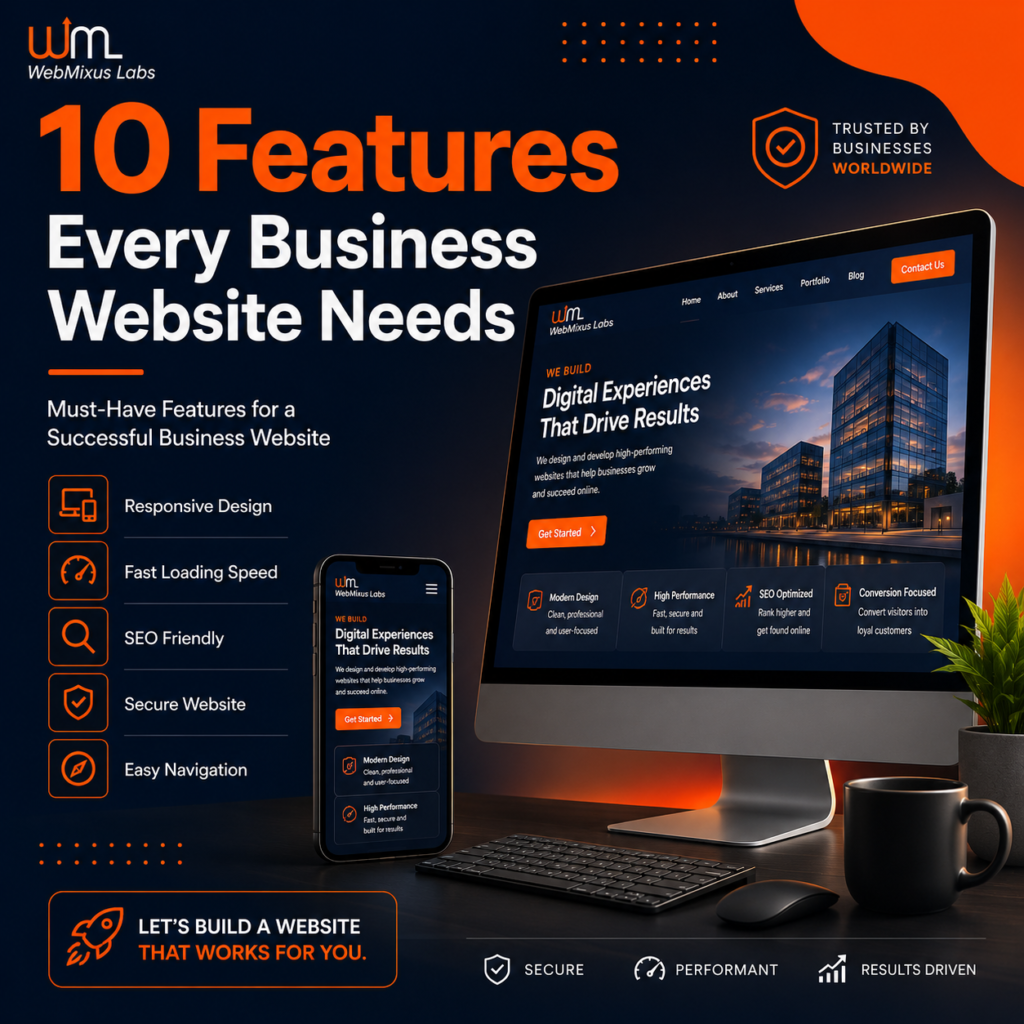
Having a basic website is no longer enough. With millions of companies fighting for search space, your website must do more than simply sit online. It has to act as a 24/7 sales representative, qualifying prospects, building trust, and converting traffic into revenue.
Many business websites fail to generate results because they miss critical features that guide the user journey. Whether you are building your first website or preparing a complete redesign, make sure these 10 essential business website features are integrated into your digital strategy.
1. Clear, Compelling Value Proposition (Hero Section)
When a visitor lands on your website, you have less than 5 seconds to capture their attention. Your “above-the-fold” section (the area visible without scrolling) must answer three questions immediately:
- What products or services do you offer?
- How will it solve the customer’s problem?
- What action should they take next?
Avoid vague corporate jargon. Use a bold headline, a supportive sub-headline, and an immediate button leading to your contact or shop page.
2. Intuitive, User-Friendly Navigation
If users cannot find what they want quickly, they will click away. Keep your main navigation menu clean and logical. Limit primary menu options to 5–7 core categories (e.g., Home, About, Services, Portfolio, Blog, Contact). Use clear descriptive dropdowns for sub-services, and always place your logo on the left, linking it back to the homepage.
3. Mobile Responsiveness
Over 55% of global web traffic comes from mobile devices, and Google uses mobile-first indexing to rank websites. If your website is hard to navigate, read, or click on a smartphone screen, your search rankings will suffer. Every layout must adapt fluidly to laptops, tablets, and smartphones. Our design team at WebMixus Labs prioritizes mobile-first layouts in all UI/UX and web development services.
4. Prominent Call-to-Action (CTA) Buttons
Your website exists to drive specific actions. Do you want visitors to call, email, download a PDF, book a consultation, or buy a product? Make it obvious.
Use high-contrast colored buttons (like our signature orange accents) that stand out against the background. Place CTAs in your sticky header, the hero section, the middle of service pages, and at the end of blog articles.
5. Trust Signals: Testimonials, Reviews, and Case Studies
Before purchasing, buyers look for social proof. Including reviews, ratings, client logos, and detailed case studies builds immediate credibility.
Highlight quotes from satisfied customers and link to in-depth project pages showing before-and-after results. If you want to see how we display results for our clients, review our Featured Projects and Case Studies page.
6. Fast Loading Speed
A website that takes more than 3 seconds to load loses about 40% of its visitors before they even see the content. Page speed is also a major Google ranking signal. Keep your site fast by optimizing images, leveraging browser caching, using lightweight code frameworks, and choosing high-quality web hosting.
7. SSL Certificate and Robust Security
Security is critical for protecting user data and establishing search credibility. An SSL certificate encrypts the data transferred between your user and the server, changing your URL prefix from `http://` to `https://`. Modern web browsers display warning messages like “Not Secure” if your site lacks an SSL certificate, which will instantly scare away potential customers.
8. Optimized “Contact Us” Page and Forms
Make it as easy as possible for customers to reach you. Your Contact page should include:
- A simple, secure contact form with minimal fields.
- A direct click-to-call phone number and clickable email link.
- Your physical office address with an embedded Google Map.
- Your business hours.
Ensure phone numbers and emails are formatted to dial or open mail clients automatically when tapped on mobile devices.
9. On-Page SEO Architecture
Search Engine Optimization (SEO) helps your website rank higher on Google when potential clients search for your services. A proper SEO setup requires:
- Clean header tag structure (only one H1 tag per page, followed by logical H2s and H3s).
- Descriptive, keyword-rich URLs (e.g., `/services/web-development`).
- Alt tags on all images so search engine bots can understand the media content.
- Schema markup to display rich results in search listings.
10. An Active Blog or Resources Section
A blog is one of the most powerful inbound marketing tools. Publishing high-quality, informative articles helps:
- Rank your website for educational keywords and long-tail searches.
- Position your company as an authority in your industry.
- Provide content for your social media channels and email newsletters.
- Keep your website active and updated, which Google’s crawl bots favor.
Conclusion
A successful business website is a balance of design, technology, security, and copywriting. If your website is missing any of these 10 features, you are leaving leads on the table. Investing in a professional web layout guarantees that your website works to expand your customer base every single day.
Is Your Business Website Ready for an Upgrade?
At WebMixus Labs, we construct stunning, mobile-responsive, and SEO-optimized websites built for conversions. Let us analyze your current website and design a custom growth strategy.
Frequently Asked Questions
1. What is the difference between a header tag and a meta tag?
Header tags (H1, H2, H3) are visible headings within your website’s content body used to organize structure. Meta tags (such as Meta Titles and Meta Descriptions) reside in the HTML code header, communicating site data directly to search engines rather than displaying on the page.
2. Do I need an SSL certificate if I don’t sell products online?
Yes. Even if you do not sell products directly, browsers mark all HTTP sites as “Not Secure.” An SSL certificate is necessary to build user trust, secure standard contact forms, and maintain your organic Google ranking position.
3. How often should I update the content on my business website?
You should review your service details and landing pages quarterly. For blogs or news sections, publishing fresh, SEO-optimized articles 2 to 4 times a month signals activity to search engines and keeps your audience engaged.
