Your website is the single most important component of your online marketing strategy. It controls your brand’s digital first impression and acts as your primary engine for lead generation. Because your website is so critical, choosing the right web development company to build it is a high-stakes decision.
Partnering with the wrong team can lead to delayed launch schedules, blown budgets, insecure code, slow page speeds, and a layout that fails to convert visitors. Conversely, selecting a professional agency ensures a smooth, transparent process and a high-converting website built to scale.
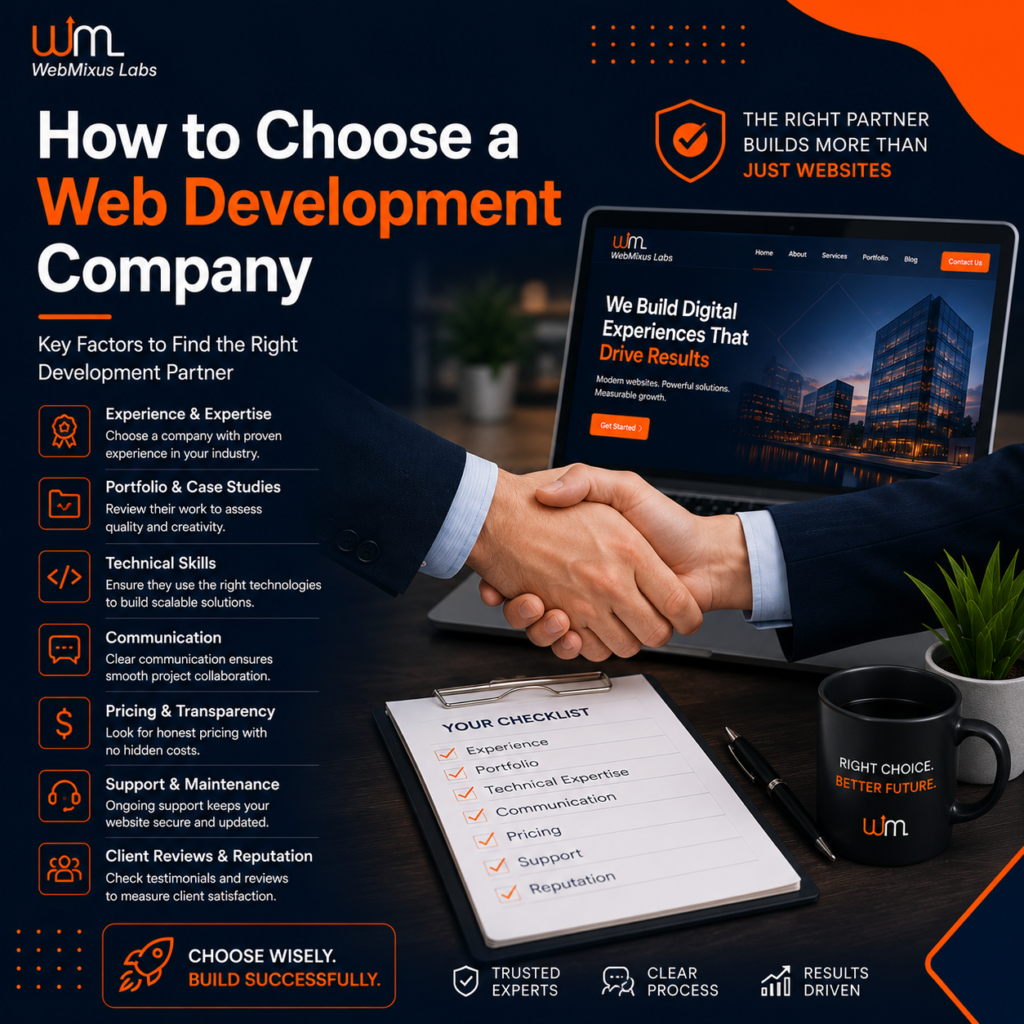
How do you filter through thousands of agencies and freelancers to find the perfect fit? Here is a step-by-step hiring guide detailing how to choose a web development company that aligns with your business goals.
1. Define Your Project Goals and Budget
Before speaking to agencies, you must clarify your requirements. Are you building a simple portfolio site to display your services, or do you need a custom e-commerce portal with automated inventory management? Write down a list of essential features:
- Do you need custom database functionality or standard templates?
- Which CMS do you prefer (WordPress, custom React app, Shopify)?
- What is your budget ceiling and target launch timeline?
Understanding your expectations allows development companies to provide accurate estimates rather than generic quotes.
2. Analyze Their Portfolio and Case Studies
A web development company’s past work is the most reliable indicator of their capabilities. When reviewing an agency’s portfolio, look beyond the visual aesthetics and ask:
- Design Diversity: Do all their client sites look identical, or do they customize the design system to fit each industry’s branding?
- Technical Execution: Visit their live client sites on your mobile phone. Do they load quickly? Is the mobile menu responsive? Are the call-to-actions obvious?
- Relevant Experience: Have they completed projects of similar scope or within your industry?
Explore our Portfolio page to review the custom-coded websites and design systems we have built for our partners.
3. Evaluate Their Technical Expertise
Ensure the team has specialized developers rather than generalist designers who rely on basic plugins. Ask what technology stacks they use:
- For content-driven business sites, do they build lightweight custom themes on WordPress, or do they install heavy, slow-loading page builders?
- For custom applications, are they proficient in modern frameworks like React, Node.js, and RESTful APIs?
- Do they understand search engine optimization (SEO) architecture and schema coding?
An agency that understands both clean frontend coding and complex backend system integrations will build a secure website that can grow with your business.
4. Research Reviews, Testimonials, and References
Client feedback tells you what it is actually like to work with the company. Look for reviews on third-party platforms like Google Business Profiles, Clutch, or LinkedIn.
Pay attention to comments regarding:
- Communication: Did they provide regular updates, or did they disappear for weeks?
- Timeline Management: Did they deliver the project on schedule?
- Post-Launch Support: Did they help resolve bugs after the website went live?
5. Ask About Their SEO and Content Approach
A beautiful website is useless if nobody can find it. Many development companies write clean code but know nothing about search rankings. A professional company must build SEO best practices into the layout:
- Proper heading hierarchy (H1, H2, H3 tags).
- Dynamic metadata structures.
- Responsive images with alt tags.
- XML sitemaps and schema markup.
Ensure their team understands how to design pages for both human readers and search engine crawlers.
6. Understand Their Process and Project Management
Web development is a complex, collaborative process. The company you hire should have a clear, structured workflow. Avoid companies that start coding immediately without a discovery phase. A proven process includes:
- Discovery & Strategy: Researching your target audience and competitors.
- UI/UX Design: Creating wireframes and design mockups for approval.
- Development: Coding the front-end layout and configuring database logic.
- Quality Assurance: Testing the site across multiple browsers, mobile screens, and speed metrics.
- Launch & Training: Deploying files to the server and training your team on how to manage content.
7. Audit Their Post-Launch Support and Maintenance Plans
A website is not a one-time product; it requires continuous security patches, plugin updates, hosting management, and database backups. Ask potential partners:
- Do they provide a warranty period for fixing post-launch bugs?
- Do they offer monthly maintenance agreements to keep the site updated?
- Who owns the website files, design assets, and domain registry once the project is paid in full? (Make sure you own 100% of your digital property).
Conclusion
Choosing a web development company is a long-term partnership decision. Take the time to audit portfolios, ask about coding frameworks, check client references, and evaluate communication styles. Investing in a professional, structured team protects your budget and ensures you launch a powerful marketing asset built for business growth.
Looking for a Reliable Web Development Partner?
At WebMixus Labs, we follow a transparent, agile process to build high-performance, secure, and visually stunning websites custom-tailored to your business goals. Let’s discuss your next project.
Frequently Asked Questions
1. What questions should I ask in the initial interview with a web agency?
Ask: “Who will write the code (in-house team or subcontractors)?”, “What CMS or tech stack do you recommend for my goals?”, “Do you handle custom UI/UX design or use pre-made templates?”, and “What happens if the project goes over timeline?”
2. Do I need to provide the website content and images?
Most web development companies expect you to provide raw copy, logos, and product photos. However, premium agencies like WebMixus Labs offer professional copywriting, graphic design, and content strategy services as optional add-ons to ensure professional results.
3. Should I choose a local web development company or look globally?
Choosing a local agency allows for face-to-face meetings and alignment on regional market behaviors. However, working with a global or hybrid team provides access to elite technical talent and competitive pricing structures, as long as they have solid communication tools and clear workflows.
