
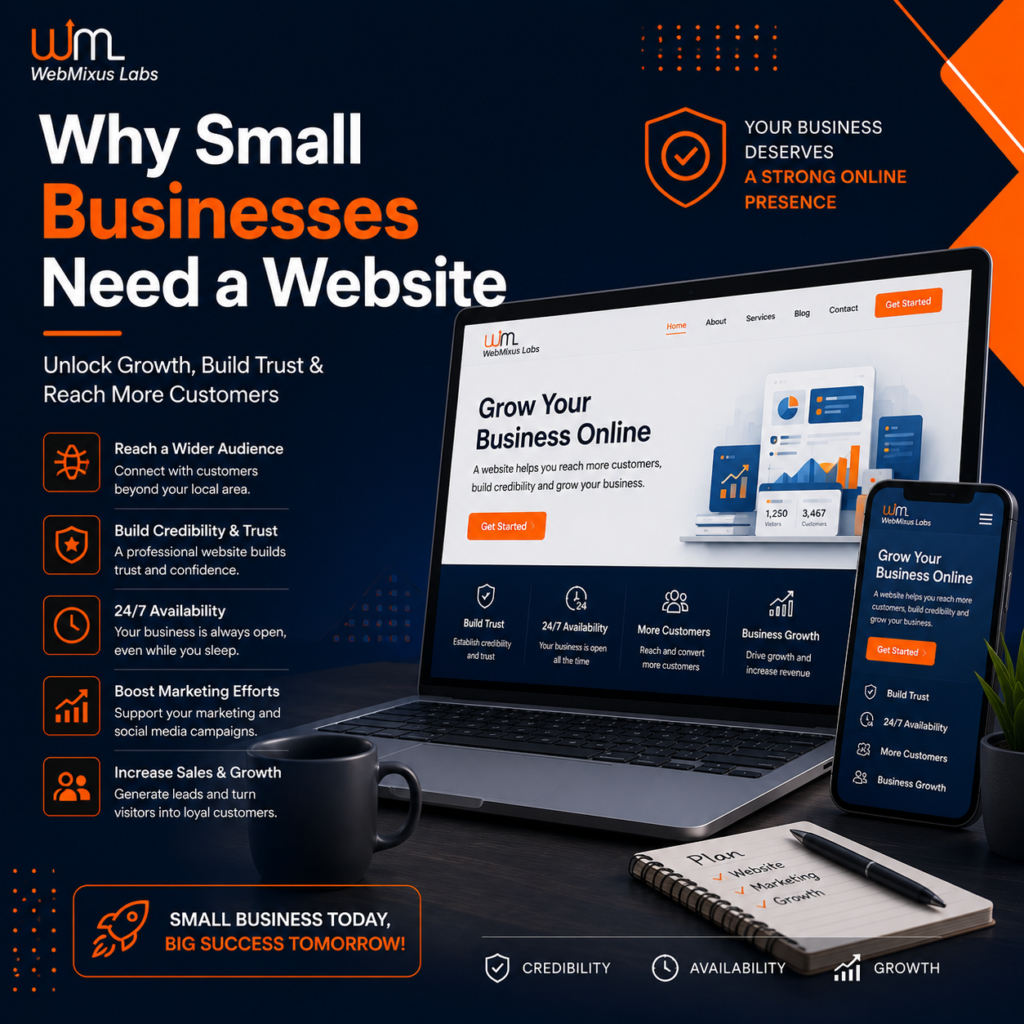
Many small business owners rely entirely on word-of-mouth recommendations, local foot traffic, or social media pages (like Facebook or Instagram) to find clients. While these channels are valuable components of a marketing plan, they cannot replace the core value of a dedicated company website.
If you think your business is “too small” or your industry is “too traditional” for a website, you are missing out on a massive pool of potential customers. Over 90% of consumers research companies online before making a purchase decision. If you do not have a website, your business is invisible to these buyers.
In this article, we will examine 8 critical reasons why small businesses need a website to grow, compete, and survive in today’s digital economy.
1. Build Instant Credibility and Trust
Modern consumers are skeptical. One of the first things a buyer does when hearing about a company is search for their website. A professional, clean website instantly signals that you are a legitimate, established business.
If your business only has a social media page, it can look temporary or unprofessional. Having a custom domain name (e.g., yourname.com) and a structured layout shows that you have invested in your brand authority, giving clients the confidence to choose you over competitors.
2. Control Your Brand Narrative
While third-party review platforms and social media channels allow you to post updates, you are subject to their rules, layouts, and algorithms. You cannot control what advertisements appear next to your content, or how your page looks.
A website gives you complete control over your brand narrative. You determine how your services are described, what case studies are featured, and what colors and fonts represent your business. Check out our Branding and UI/UX design services to see how we help businesses build cohesive brand identities online.
3. Attract Customers Through Google Search (SEO)
Every second, millions of people use Google to search for local services. If a customer searches for “plumber near me,” “web developer in India,” or “organic bakery,” and you don’t have a website, you will never show up in those search results.
A search-engine-optimized website indexable by Google allows you to attract a steady stream of “warm” organic leads—people actively searching for the solutions you provide. This inbound marketing pipeline is far more cost-effective than cold calling or traditional print advertising.
4. Showcase Your Portfolio and Testimonials
Your website is a dynamic gallery of your best work. Instead of telling clients what you can do, you can show them.
A portfolio section allows you to present high-resolution images, detailed descriptions of your process, and client reviews. This proof of capability makes it much easier to close sales. Review our Portfolio page to see how we showcase professional web designs to convert leads.
5. Own Your Digital Real Estate (No Algorithm Risks)
Relying solely on social media platforms is highly risky. Social platforms change their algorithms overnight, which can cut your organic reach in half. Even worse, if your account is hacked, suspended, or shut down by the platform, you lose your entire follower base and customer channel instantly.
Your website is your digital property. No third party can take it down or restrict your reach. It is an asset that grows in SEO value over time, providing a secure, stable foundation for your business growth.
6. Operate 24/7 (Even When You Sleep)
Your physical office or store has closing hours, but your website never sleeps. Potential clients can read about your services, download brochures, book consultations, or purchase products at 2 AM on a Sunday. By automated forms and intake systems, your website generates qualified leads while you focus on running your business.
7. Level the Playing Field with Larger Competitors
A small business cannot match the multi-million dollar advertising budgets of industry giants. However, a professionally designed, fast, and highly informative website can rank right alongside them on Google. A clean, custom layout from a premium agency makes your startup look just as professional and capable as an enterprise competitor, building consumer confidence.
8. Capture Essential Customer Data
To scale a business, you need data. Your website allows you to implement tracking systems like Google Analytics to understand:
- Who your visitors are (demographics, location).
- How they found your business (search engine, social media, direct).
- What services or pages interest them the most.
This analytics data takes the guesswork out of your business decisions, allowing you to focus your marketing budget on the channels that drive the highest ROI.
Conclusion
A website is not an unnecessary expense; it is a fundamental business asset that pays for itself by expanding your customer base and automating lead generation. Without a website, you are handing your market share directly to your competitors. Whether you need a simple brochure site or a custom solution, the time to build your online presence is now.
Ready to Establish Your Brand Online?
At WebMixus Labs, we build fast, mobile-friendly websites designed specifically to help startups and small businesses compete and succeed. Let us create a digital footprint that drives results.
Frequently Asked Questions
1. Can I just use a Facebook or Instagram page instead of a website?
No. While social media pages are excellent for engagement and direct messaging, you do not own them. Changes in platform algorithms can limit your visibility, and a social page lacks the customization, deep SEO structures, and trust-building capabilities of a professional domain.
2. How much does it cost to maintain a small business website annually?
For a basic small business website, annual recurring costs include domain renewal (approx. ₹1,000) and hosting (approx. ₹3,000 – ₹10,000). Professional security maintenance and backup plans can add ₹12,000 – ₹30,000 annually, depending on your needs.
3. What is the minimum number of pages a business website should have?
Most small business websites start with 4 to 5 pages: Home, About Us, Services, Portfolio (or Testimonials), and Contact Us. This structure is sufficient to build trust, showcase value, and capture leads.
